
FX Decision Data

Greater returns.
Better financial stability.
More time for what matters.

Enhance your currency results with data-driven FX risk management: the right moment to convert foreign currency receivables, the right moment to settle payments in foreign currency, and an early warning before a trend turns.
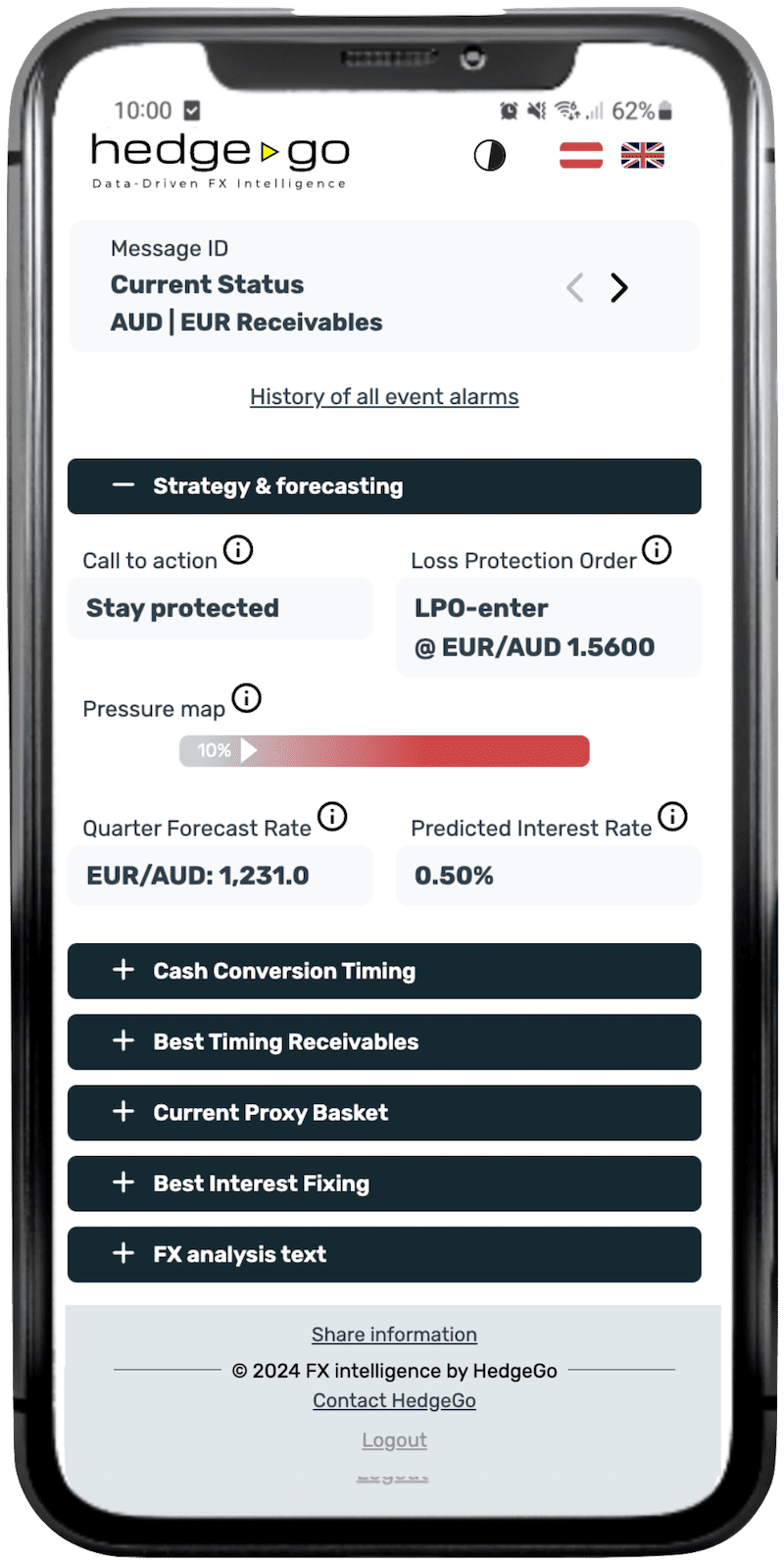
FX risk management is important

Market volatility, unpredictable rates, and the constant obligation to monitor trends may leave you exposed to unnecessary losses on the balance sheet or in your cash flow.

How do you get the most out of your FX risk management?

You can implement fixed processes, but not all areas of the business are suitable for them. Beyond that, you can use basic forecasting tools or bank forecasts, or draw on our analysis to optimise hedging decisions.

HedgeGo integrates 27 years of analytical experience with machine learning methods to create models for the systematic management of currency, commodity and interest rate risks.

What makes HedgeGo different

We turn inefficient processes into three automated, systematised solutions.

Icon representing Cash Conversion Timing

Cash Conversion Timing (CCT)

Turn uncertainty into stability. CCT helps your company convert foreign currency receivables at the optimal time, minimising exchange rate risks and relieving your treasury of repetitive work.


Icon representing Best Timing Payables

Best Timing Payables (BTP)

Pay smarter, not just on time. BTP identifies the optimal moments to make foreign currency payments within a three-week window before the due date, which reduces the impact of rate movements on what you pay.


Icon representing the Pressure Map

Pressure Map (PMA)

See currency risks before they hit. PMA gives treasury an early warning when a currency trend is likely to change within the next five business days, leaving time to prepare.


Curious how our systems work in practice? See how companies use them in real situations.

Ready to optimise your FX risk management?

We provide transparent pricing for our services. The calculator shows what a subscription costs for your currency pairs and volumes.

A solution for your commodity price risk

Our goal is to reduce 80–90 % of your commodity price fluctuation risk. We do that by measuring your specific price change risk from your own purchase data and mirroring it with a basket of tradable materials, for materials where no direct hedge exists.

Stay ahead with expert insights

Our blog covers market analysis and updates on currency developments.

The Majors Are Showing Weaker Trends, Including the CHF

The global economy is in good shape. If you read the German media, however, you might think that we are on the brink of economic Armageddon. The truth is that Europe, as well as Australia, Japan and Canada (the 'majors'), are in a difficult situation. The sovereign...

The War With Iran Is Coming to an End

This Is Good News for Stock Market Performance This Year In this issue, I will be examining a wide range of factors that are set to become important in the years ahead. While the impact of AI on the labour market is widely debated, does this necessarily lead to an...

An Early End to the War Would Revitalise Asia

Growth rates in Asia have proven to be remarkably resilient so far. While the ongoing blockade of the Strait of Hormuz is certainly a cause for concern, I believe this could end very soon. If that happens, we can expect another significant upturn in the global...

The EUR/USD Exchange Rate Has Remained Unchanged Since April 2025

To understand the movements in EUR/USD over the past year, it is not helpful to pay too much attention to what is written or said about it online or on LinkedIn. In fact, over the past 13 months, the EUR/USD exchange rate has fluctuated by only +/- 3% within a fairly...

Weakness of the Pound, Strength of the Aussie

The performance of the major currencies against the euro varied last month, but they remained strong against the US dollar throughout. Both the pound and the yen still face the prospect of weaker exchange rates. While the pound is fairly valued or slightly overvalued,...

If the Situation Continues to De-Escalate, CEE Currencies Will Continue to Strengthen

Peter Magyar’s decisive election victory is a sensation, even if the exact nature of the changes to Hungarian politics is unclear. The only thing that is clear is that the Orbán system has collapsed, despite the highest regulatory hurdles being in place. Magyar can...

The USD Continues to Show no Clear Trend

The USD remains flat. In the editorial of Issue 8, I outlined a risk scenario that is becoming increasingly likely while the US continues to block the Strait of Hormuz unrestrainedly. This measure is tactically understandable, as it prevents the Tehran regime from...

If the U.S. Drags its Feet in Iran, Things Will Get Tight

If the U.S. does not want to be held responsible for triggering a global economic crisis with this disastrous war, I think it is now under considerable pressure to agree to a peace deal with Iran. A long time ago, I noticed that virtually every stock market and...

Operation Fury and Economic Fury

The Names Given to the Measures Against Iran Are as Aggressive as They Are Straightforward In this issue, I would like to take a closer look at the state of the U.S. economy, examining debt, growth and inflation trends. I believe that examining these aspects in more...

The War Against Iran Is Causing CEE Currencies to Falter

The 'surprise war' launched by the US and Israel against Iran has not only caused stock markets to plummet in recent days — a 8% drop over two days is not even a particularly strong reaction — but has also effectively doubled the price of petrol. Situations like this...

Still have questions?

Use the form below and we will come back to you.

Name