Peter Magyar’s decisive election victory is a sensation, even if the exact nature of the changes to Hungarian politics is unclear. The only thing that is clear is that the Orbán system has collapsed, despite the highest regulatory hurdles being in place. Magyar can now exploit the full power of the former system to enact reforms that could ultimately result in its demise. Time will tell whether Magyar will be able to resist the temptation to carry this out, thus making it easier for himself to be voted out of office.
For the time being, the forint is performing well, and this is not just because of the new political climate and the expected access to EU funds.
A Genuine End to the War With Iran Would Be a Positive Development
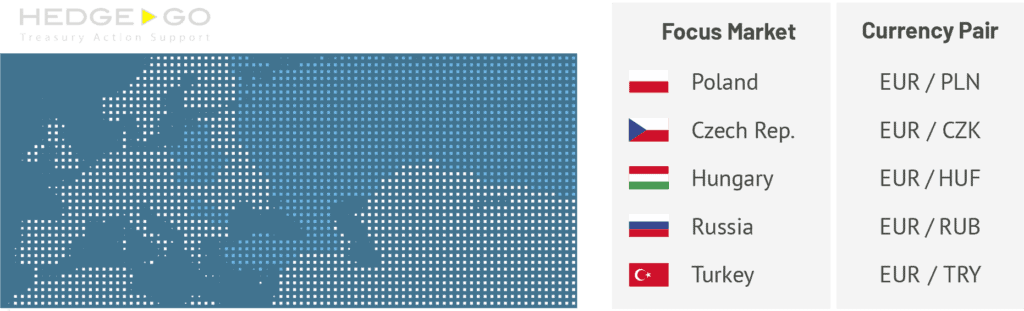
The outbreak of war nine weeks ago had an impact on emerging markets, triggering a sell-off of emerging market currencies. This issue features all of the currencies affected.
The mere end of active hostilities and the prospect of peace talks brought an end to the ‘strong dollar’ and the slump in the stock market. While the zloty and the koruna remain slightly weaker against the euro, the forint has jumped significantly upwards, which is solely down to the ‘Magyar effect’. This is also related to the fact that Orbán’s policies have weakened Hungary considerably in recent years, which was probably the main reason for his electoral defeat, despite his many successes up until 2022. In recent years, the forint has proven to be significantly weaker than the koruna. Now that there is a real chance of a turnaround, the stigma and excessive weakness of the forint are quickly being shed. Magyar must now deliver, and I expect him to do so.
The Ruble and the Turkish Lira Face Challenges
Russia is experiencing sluggish economic growth, a fact that President Putin has now publicly acknowledged. This is rather unusual in times of war, when the production of weapons and related goods is expected to stimulate economic growth.
This means that the overall economy is in a severe recession, and an end to the war would expose this without mercy. Not only is Ukraine succeeding in preventing further territorial gains, it is also increasingly eliminating strategic targets deep within Russia and attacking energy hubs.
The war against Iran poses a challenge for Turkey, in part because the Turkish lira (TRY) has come under strong depreciation pressure, which has been stabilised through gold sales. The TRY is a prime example of a manipulated currency, as evidenced by its particular relationship with the USD. Currently, it makes perfect sense to hedge TRY receivables with an EUR/USD hedge. This significantly reduces hedging costs and covers the actual depreciation component of the USD’s performance. The TRY is currently depreciating against the USD at a controlled rate of around 15% per annum while yielding 37% interest, enabling a real return of 22%. After deducting hedging costs against the USD, exporters to Turkey are left with around 20% of this return. For importers, the current difference between the depreciation rate and interest income represents a worthwhile investment that should certainly be structured on a permanent basis using interest rate swaps.
If the war in Iran comes to an end, the price of oil is expected to fall. This would be good news for the rest of the world, but not for Russia. Ultimately, wars either bleed out in the strictest sense of the word, or more often than not, they end when their economic foundation erodes. It is the latter that will prompt Putin to seek a way out.