The USD started the new year weakly. There was temporarily very high pressure, causing the USD to fall to 1.2050 against the euro. Currently, the USD is hovering around the 1.18 mark, and I expect this to be the average exchange rate over the coming weeks.
If you need to make purchases in USD, it would be advisable to wait until the EUR/USD rate is between 1.19 and 1.1950.
If you need to hedge your USD receivables at short notice, it would be possible to do so at a rate of EUR/USD 1.17.
Minneapolis Has Consequences
In addition to the ongoing Epstein Files scandal, the deaths of US citizens are becoming an increasingly heavy burden for Donald Trump and his team, including Kristi Noem, Peter Hegseth and Steven Miller.
With the midterms approaching, the outlook for the Republicans and Trump is looking grim. This provides the opposition with an excellent opportunity to attack the administration’s weaknesses, which are exacerbated by its excessive harshness.
The situation is escalating, resulting in miserable poll ratings, which will also weaken the Republicans’ loyalty to Trump, limiting his room for manoeuvre. This will make the urgent reforms that are needed virtually impossible, and will make the fundamental weakness of the US increasingly precarious.
In terms of domestic policy, it is clear that states bordering Canada in particular are becoming increasingly vocal about economic issues and rising unemployment. This issue is being emphasised more and more loudly. Overall, there is a clear weakening of momentum within US domestic policy, with internal divisions increasing. This will affect how other countries view the security of investments in the US. This will put additional pressure on the USD.
The USD Is Falling Across the Board
The euro is constantly in the spotlight for European corporations. I chose this headline because, aside from the euro, it is clear that the US dollar is not in the best shape either.
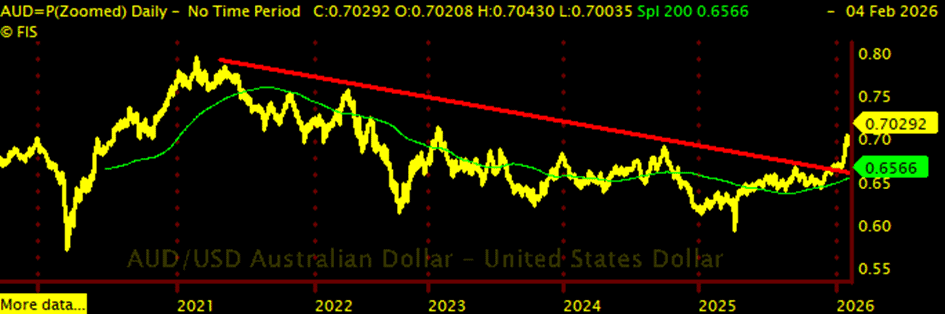
The AUD has risen significantly against the USD. The AUD’s long-term downward trend has already been broken. For the euro, this will only be the case once it exceeds 1.25 against the USD. I expect this to happen before the end of the year, possibly in the first half.
However, the situation will only become critical for the US if the yen begins to appreciate. While it is certain that the yen will appreciate, unfortunately it is not clear exactly when this will happen. I therefore recommend hedging EUR/USD receivables over a period of several years.
Given the obvious risks for the USD, it would be unwise to be negligent with your budget.
There is still a little time left. In the next issue, I will present the current examples of option costs that were requested today.