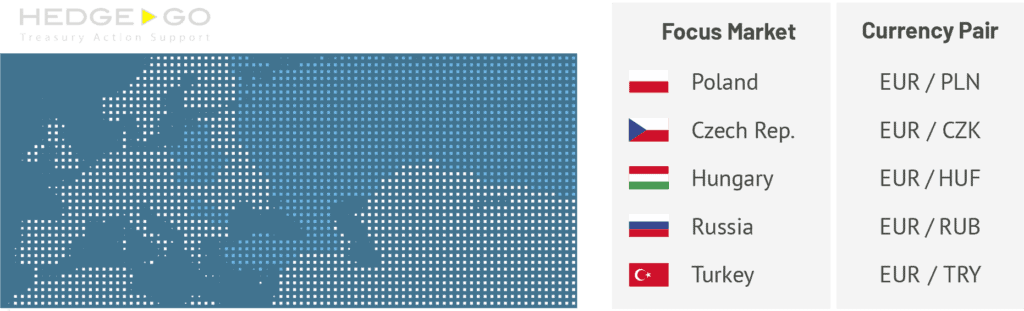
It is encouraging that there are no immediate risks on the horizon, meaning we can expect stability in developments. While the slow appreciation of currencies is unwelcome news for buyers in the CEE region, those who have kept their eyes open have been able to profit from favourable exchange rates and positive interest rate differentials by hedging their currencies. Development in the CEE region remains stable.
Active Risk Management Is Advisable
For those generating income in these currencies, the rise in CEE currencies has been a godsend, provided they followed our recommendation to replace ‘hard hedges’ with stop limits. This has enabled them to avoid hedging costs and generate windfall profits. This is not speculation, but the deliberate exploitation of identifiable trends secured with stop limits. It is a form of risk management designed to protect the company’s cash flow and liquidity. In my opinion, liquidity protection is rarely addressed in corporate processes. Companies fail to realise that neglecting liquidity increases their financing costs in the long term and thus worsens their rating. For the past 10 years, I have been supporting companies in active risk management and optimising the balance between ‘hard hedging’ and stop hedging with a limited risk budget. During this time, I have learned that this concept is not widely adopted by companies because unplanned actions in the past have led to greater disadvantages, making appropriate risk management seem unwarranted today.
We Have Some Time
Due to the ‘reluctance’ of the companies mentioned above, I have not always been successful in implementing meaningful risk management. Over the past 10 years, it has mostly been too easy for companies to protect themselves because business success was still satisfactory. However, today, when things are becoming more difficult, I consider it a serious failure that little use was made of these last 10 years. The industry’s foundations could be much more solid than they are.
Although the situation is not ideal, it would be disastrous to refrain from conducting hedging transactions that are appropriate to the situation and responding adequately to real market changes. It will be slightly more challenging to demonstrate flexibility when volatility increases, which I expect will happen for the rest of the decade.
If you think the markets are volatile now, just wait! In the EUR/USD market, we’re currently experiencing just 60% of the volatility seen between 1971 and 2012, and only a third of the maximum fluctuations.
Fortune Favours the Prepared
2026 Gives Us Time to Prepare
I cannot currently identify any immediate triggers for problems. This is reassuring, as it suggests that the current positive developments will continue.
However, we cannot assume that this will always be the case and must prepare to respond appropriately to any changes that may occur. Experience also needs to be gained in this area so that we can respond appropriately to change without incurring significant costs.
The problem with high volatility is that it puts us under pressure. However, you can learn to cope with pressure, which enables you to deal with it rationally and succeed.
I expect the war in Ukraine to end, which will have a particularly positive impact on Poland, Slovakia, the Czech Republic and Hungary.
I expect the rouble to rise significantly, while the Turkish lira will stabilise.